Course Overview
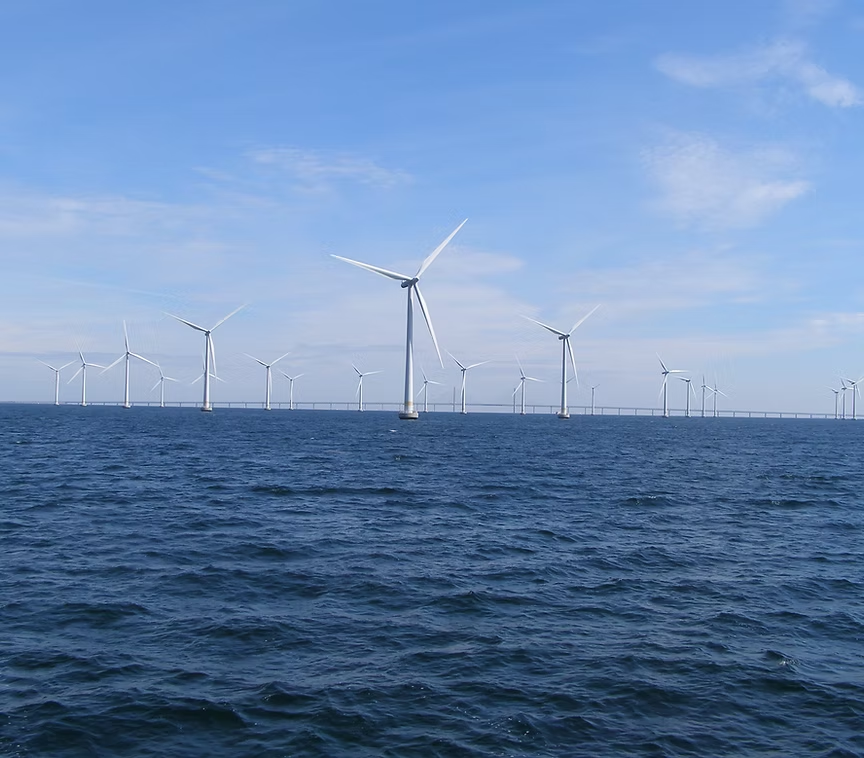
This course introduces a powerful family of tools known as dimension reduction methods. These methods make it possible to analyze large datasets and develop fast, accurate reduced-order models. The course progresses from dimensional analysis to Fourier decomposition, Proper Orthogonal Decomposition (POD), and machine learning-based autoencoders. The focus is not on treating methods as black boxes. Instead, you will learn to understand what they reveal about the physical structure of atmospheric and wind farm flows, and how to use them in practice. You will work with turbulent flows directly relevant to wind energy, including atmospheric boundary layers, wind farm flows, and wake dynamics. The necessary mathematics are introduced intuitively, enabling you to apply the methods confidently and interpret results meaningfully. By the end of the course, you will have a solid foundation for understanding and applying modern data-driven modeling approaches in both research and industry.
Course Highlights
Apply methods to realistic atmospheric and wind farm flow datasets relevant to industry. Progress from classical dimension reduction techniques to machine learning approaches in one coherent framework. Learn to interpret results physically rather than relying on black-box models. Gain tools that are increasingly in demand across the wind energy sector.
MAIN GOAL
This course is intended to assist engineering professionals in the wind energy sector looking to deepen their understanding of data-driven methods and apply them confidently in research or industry workflows. It can also provide an introduction for MSc and PhD students in engineering or applied science to dimension reduction and reduced-order modeling, or for researchers and academics working with atmospheric or turbulent flow data who want to expand their methodological toolkit beyond traditional approaches. Furthermore, it can be undertaken by industry professionals with a background in fluid mechanics or wind energy who feel the gap between state-of-the-art data-driven models and their own ability to interpret and apply them.
Learning Outcomes
After completion of this course, you will gain the ability to:
- + Structure, process, and analysis of large flow datasets efficiently
- + Apply decomposition methods such as Fourier analysis, POD, and autoencoders to turbulent flow data
- + Develop reduced-order models for fast and accurate flow modeling
- + Interpret data-driven results and connect them to physical flow behavior
- + Critically evaluate the strengths and limitations of different methods and select the appropriate one for a given problem
- + Understand and analyze the statistical and stochastic nature of turbulent flows
Meet Your Instructors

Associate Professor
Admissions
Entry Requirements
- + Background in wind energy engineering, specifically the fundamentals of wind energy flows, such as wind turbine wakes, wind farm flows, and atmospheric boundary layers
- + Basic courses in fluid mechanics, linear algebra, and time series analysis.
- + A computer capable of running Python, Jupyter notebooks, or MATLAB
- + Scripting in MATLAB or Python
Teaching and Assessment Methods
- + This course is hybrid (online or on-campus, synchronous only).
- + During the first three days, there will be lectures followed by hands-on exercises covering the most important aspects of the data-driven methods in the context of wind turbine flows.
- + Over the following days, the students will focus on a project on a flow of their choice: wind turbine wakes, wind farm flows, or the atmospheric boundary layer.
- + This project provides the opportunity to apply the knowledge from the lectures on realistic flows found in the wind energy industry and requires the physical interpretation of the methods applied rather than relying on black-box models.
- + The coding of the exercises is expected in Python or MATLAB.
- + The course requires one week of full-time availability, during which the first days are focused on lectures and exercises, and the subsequent days focus on the course’s project. After this week, students will have a few days to finish and hand in their project.
Application Deadline: TBC.
Practical Notes
- + Assessment of the achieved learning objectives will be based on the course project, which is defined by the teacher and carried out by the learner on their preferred flow case scenario from three available options.
- + Participants who successfully complete the course will be awarded with a microcredential from DTU. If the participant prefers, we can give a 2 ECTS microcredential.
Fees & Funding
Tuition Fees
Visit institution page for information on fees and application deadlines.
Click here to visit institution page
Course Info
Contact Søren Juhl Andersen for any additional information relating to this course.