
Course Overview
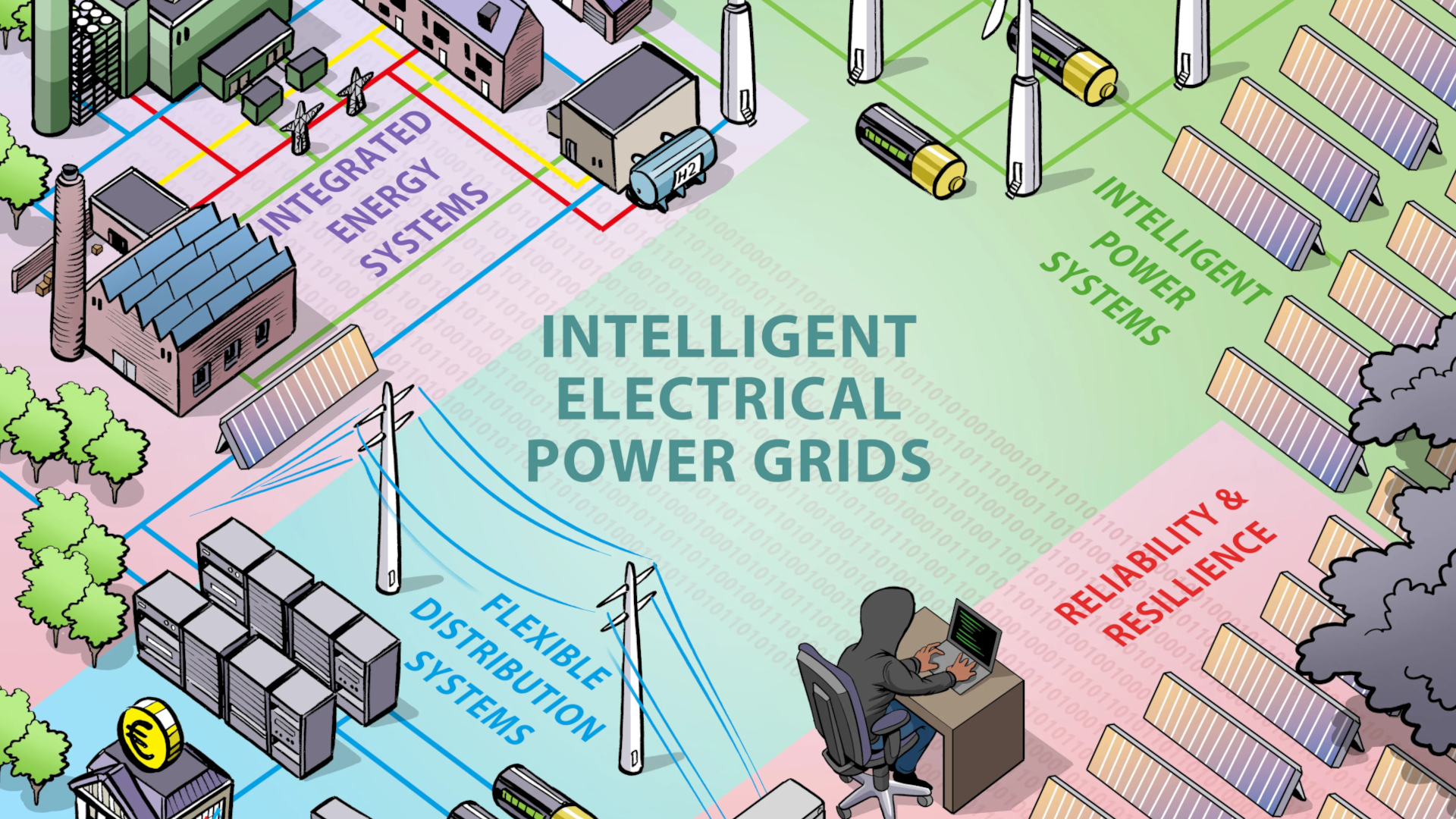
Intelligent Electrical Power Grids - a.k.a. Smart Grids - are the "smartified" version of our electricity infrastructure. By adding controls, communication, and other digital elements these grids are expected to be more flexible, robust, efficient, and capable in order to satisfy the requirements of the future: hosting more renewable sources, catering for an active demand side, or implementing flexible peer-to-peer energy markets.
Course Highlights
Placeholder Text.
MAIN GOAL
Working with Smart Grids requires knowledge in a variety of disciplines out of electrical engineering, computer science, and mathematics. Of great importance is modeling and simulation, since Smart Grids show a level of complexity and heterogeneity that often can not be covered by analytical methods. In this course you will learn how to describe and assess a Smart Grid, mainly by using numerical tools. You will use various modeling and simulation tools to investigate the properties of smart power grids. Each practical results in a short report. In the end, an electronic exam will be done.
Learning Outcomes
After completion of this course, you will be able to:
- + Describe the smart functions of energy management systems.
- + Deploy software-based models for steady-state and market performance analysis.
- + Synthesize operational scenarios for insecurity risk identification.
- + Apply data analytics and optimization for intelligent flexibility management.
- + Solve operational security threats of systems (e.g. TSO-DSO, offshore/onshore systems, large/small size hubs) with different characteristics.
Meet Your InstructorS
/https%3A%2F%2Ffilelist.tudelft.nl%2FPersonen%2Fz87f0.jpg%3Fhash%3D530841b7bd)
Professor
/https%3A%2F%2Ffilelist.tudelft.nl%2FPersonen%2Fh9o5c3.jpg%3Fhash%3Dcba8acd318)
Associate Professor
/https%3A%2F%2Ffilelist.tudelft.nl%2FPersonen%2F0h3t4.jpg%3Fhash%3Db82e25de6f)
Associate Professor
/https%3A%2F%2Ffilelist.tudelft.nl%2FPersonen%2Fv8j5g1.jpg%3Fhash%3Db77339948e)
Assistant Professor
Admissions
Entry Requirements
- + None.
Teaching and Assessment Methods
- + Lectures
- + Assignment reports
- + Computer Exam
Application Deadline: TBC
Fees & Funding
Tuition Fees
TBC